

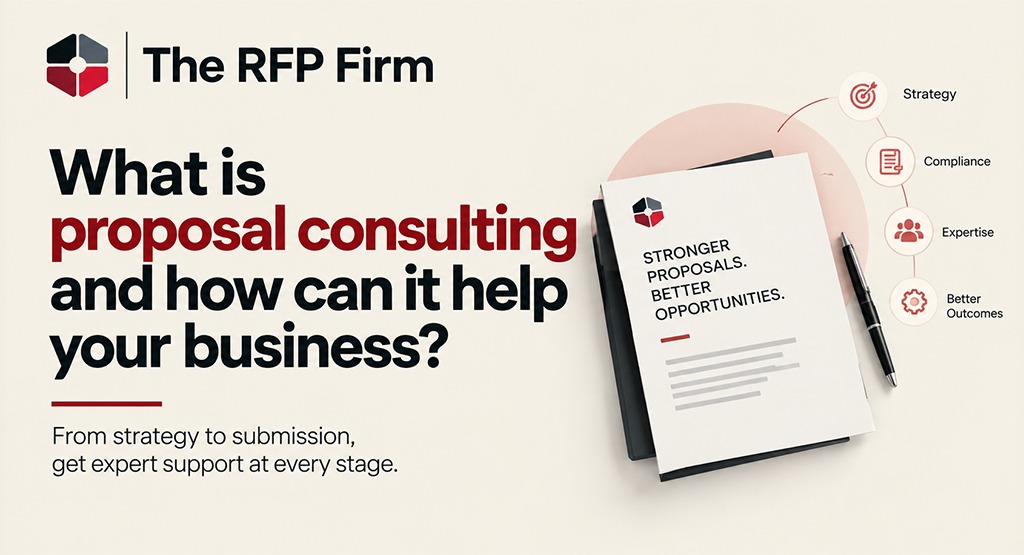
What is proposal consulting and how can it help your business?
A strong proposal doesn’t just happen because your business has good services or solid experience behind it. Someone has to translate that experience into something organized, tailored to the opportunity, and genuinely easy for the client or evaluator to follow. For businesses juggling multiple RFPs and government requests at once, that translation work gets complicated fast.
That’s where proposal consulting earns its place. A proposal consultant helps you understand what a solicitation is actually asking for, build a response strategy around it, organize scattered information into a coherent proposal, and run the quality and compliance checks that catch problems before submission.
What is proposal consulting?
Proposal consulting is professional support aimed at helping your business develop, evaluate, and strengthen proposals for competitive opportunities, whether that’s a government RFP or a commercial bid. It’s not a single service so much as a set of capabilities you can draw on wherever your team needs the most help.
Consultants can step in at any stage of the proposal lifecycle. Some businesses need help deciding whether an opportunity is even worth pursuing; others already know they want it and need help getting a strong proposal out the door on a tight deadline.
What does a proposal consultant actually do?
The exact scope shifts with the project, but the work a proposal consultant takes on typically includes:
- Analyzing RFPs, RFQs, RFIs, and similar solicitation documents.
- Identifying the requirements and evaluation criteria that matter most.
- Developing compliance matrices.
- Creating proposal outlines and schedules.
- Developing response strategies.
- Writing technical and management sections.
- Organizing past performance information.
- Coordinating subject matter expert contributions.
- Editing and proofreading.
- Conducting compliance and quality reviews.
- Supporting final proposal production.
The goal isn’t just a correct proposal it’s a response that genuinely lines up with what the client or contracting organization said it wanted.
Why do businesses turn to proposal consulting?
Most businesses know their own services extremely well but don’t have a dedicated proposal team sitting around waiting for the next RFP. So proposal development becomes one more task piled onto executives, salespeople, technical staff, or operations on top of the jobs they were already hired to do.
That setup can work fine for a straightforward proposal. It tends to break down fast on anything complex, where coordinating inputs from five different people under a hard deadline becomes its own project.
What problems can proposal consulting solve?
A proposal consultant is typically brought in to solve a specific, recurring pain point rather than a vague sense that things could be better. The most common ones include:
- Limited internal proposal-writing experience.
- Tight submission deadlines.
- Multiple proposals being developed at once.
- Difficulty interpreting lengthy solicitations.
- Inconsistent information from different contributors.
- Weak alignment between requirements and responses.
- Missing forms or supporting documents.
- Excessive repetition or generic content.
- Insufficient time for final quality control.
A good consultant brings an outside perspective while still leaning on your subject matter experts for the technical and operational accuracy only your team can provide.
Can proposal consulting help small businesses?
It can, even without a dedicated proposals department. The federal government aims to award at least 23% of prime contract dollars to small businesses every year, which means the opportunity is real but only if your proposal is strong enough to compete for it. Consulting lets a small business draw on proposal expertise exactly when it’s needed, instead of carrying that overhead year-round.
How proposal consulting makes proposal writing more effective?
Good proposal consulting turns a dense solicitation into an actual response plan, rather than a scramble to answer questions as they’re noticed.
How does RFP analysis support better proposals?
Before any writing starts, a consultant reads the solicitation closely to pin down what your business needs to provide and exactly how the response will be evaluated. Skipping this step is how businesses end up writing a technically strong proposal that still misses what the evaluator was actually scoring.
The areas that matter most usually include:
- Scope of work.
- Mandatory requirements.
- Evaluation factors.
- Submission instructions.
- Page limits.
- Required forms.
- Staffing requirements.
- Past performance requirements.
- Pricing instructions.
- Certifications and representations.
- Deadlines and amendments.
For federal opportunities specifically, SAM.gov lets businesses search by keyword, NAICS code, set-aside status, and several other filters to narrow in on the right opportunities.
What is a compliance matrix and how does it help?
A compliance matrix links every requirement in the solicitation to the proposal section that addresses it and the person responsible for writing it. It’s the tool that keeps a complex proposal from quietly dropping a requirement somewhere between the outline and the final draft.
| Requirement | Proposal location | Responsible party | Status |
|---|---|---|---|
| Technical approach | Technical approach | Operations | In Progress |
| Relevant experience | Past performance | Management | Complete |
| Staffing requirements | Staffing plan | HR / Operations | Pending |
| Required forms | Attachments | Administration | Complete |
| Pricing | Price proposal | Finance | In Progress |
This gives your proposal team one central place to track requirements throughout development, instead of relying on memory or scattered notes.
How proposal consultants improve proposal content
Once you know what’s required, the next challenge is communicating your business’s capabilities in a way that’s actually about the client’s needs, not just about you.
How do consultants create client-focused proposals?
A common weak spot is a proposal that spends too much time describing the business and not enough connecting that description to what the client asked for. A stronger response follows a clear chain: requirement, proposed approach, capability, evidence, expected outcome.
So instead of simply stating that your business has experienced personnel, a well-built proposal specifies how those specific people would be assigned to the work, what role they’d play, and why their experience is relevant to this particular requirement rather than experience in general.
How do consultants use subject matter experts’ input?
Your technical people usually hold the most valuable information in the business, but they’re rarely the ones with time to write a proposal section from scratch. A consultant can interview subject matter experts directly, pull out what backs up their answers, and turn that into finished proposal text.
That division of labor lets your technical staff focus on accuracy while the proposal team focuses on structure, tone, and responsiveness instead of asking one person to do both under deadline pressure.
What are the business benefits of proposal consulting?
The value of proposal consulting goes beyond any single document. Done consistently, it helps your business build a more repeatable process for pursuing opportunities instead of reinventing the approach every time.
Can proposal consulting save internal resources?
It can. Rather than pulling several employees away from their regular jobs to handle research, writing, formatting, editing, and compliance, your business can assign those responsibilities to an experienced external team instead.
That frees your internal people to stay focused on:
- Technical input.
- Pricing.
- Business operations.
- Client relationships.
- Project delivery.
Can it reduce proposal compliance problems?
A dedicated review process catches issues before they ever reach the government or client’s desk. A thorough final review typically checks requirement coverage, required forms, page limits, formatting, signatures, attachments, cross-references, company names and contact information, pricing consistency, and submission instructions.
Consulting can’t guarantee an award, but tighter compliance and organization consistently cut down on the avoidable mistakes that knock otherwise strong proposals out of contention.
When should you hire a proposal consultant?
Not every proposal needs outside help. The right call usually comes down to how complex the opportunity is, how much internal bandwidth you actually have, and how much the contract matters to your business.
What are the signs you need proposal consulting?
Consider bringing in professional support when:
- Your team is responding to its first government RFP.
- The solicitation contains extensive technical requirements.
- Multiple departments need to contribute.
- Proposal deadlines are difficult to manage.
- Your internal team has limited proposal experience.
- A high-value opportunity requires extensive documentation.
- Previous proposals have been technically strong but poorly organized.
- Your organization is pursuing several opportunities at once.
You don’t have to choose between doing everything in-house or outsourcing the whole process plenty of businesses bring in a consultant for specific pieces and keep the rest internal.
How should you select a proposal consultant?
A good proposal consultant should understand proposal writing as a discipline and understand your specific opportunity type the two aren’t the same thing, and you need both.
What should you evaluate?
Before signing on with a consultant, look closely at:
- Relevant industry experience.
- Government contracting knowledge, when applicable.
- RFP analysis capabilities.
- Technical writing experience.
- Compliance review processes.
- Proposal management capabilities.
- Communication and responsiveness.
- Experience with similar proposal types.
Ask how they gather information, manage revisions, handle deadlines, and run final quality reviews. A consultant worth hiring works from verified company information and won’t pad your proposal with unsupported claims, statistics, experience, or certifications.
Enhance the proposal process
Proposal consulting lets your business tap into expert resources without building out an entire proposal department. It can take on the hardest parts of the process RFP analysis, compliance management, writing, editing, and review so your team isn’t carrying all of it alone.
The real value isn’t making a proposal look polished. It’s building a structured process that actually connects the solicitation’s requirements to your business’s real capabilities, proposal after proposal.
For businesses pursuing competitive commercial or government opportunities, professional proposal support can help you:
- Organize complex requirements.
- Present capabilities more clearly.
- Reduce avoidable compliance issues.
- Manage internal resources more efficiently.
- Create a more consistent proposal development process.
If you’re looking for a professional partner to support your proposals, The RFP Firm is worth a conversation.
Frequently asked questions
It’s professional support that helps businesses plan, develop, review, and improve proposals for competitive opportunities, whether that’s a government RFP or a commercial bid.
A proposal consultant analyzes solicitation requirements, develops response strategy, coordinates input from subject matter experts, writes proposal sections, reviews compliance, and prepares the final response for submission.
Not at all proposal consulting applies just as well to commercial bids, tenders, grants, and other competitive opportunities as it does to government RFPs.
Proposal writing is focused specifically on producing the written content. Proposal consulting is broader it can include opportunity assessment, strategy development, compliance planning, writing, project management, and quality control together.
Small businesses without an in-house proposal writer are often the ones who benefit most, since outside consulting gives them access to expertise they’d otherwise have to build from scratch.
Consider it when the opportunity is complex, the deadline is tight, your team’s proposal experience is limited, several people need to contribute, or the contract is simply too important to risk a rushed response.
No reputable consultant will promise a win. What they can do is make your proposal organized, responsive, and compliant the final award decision always stays with the client or agency.
Recent Posts
- What is proposal consulting and how can it help your business?
- Government request for proposal: A complete guide for businesses
- What is a request for proposal: Everything you need to know
- Format of business proposal: A complete guide for beginners
- The best proposal template Canada businesses can use in 2026