

What do government contracts consultants do? A complete guide for businesses
Attaining government contracts consultants is not only about seeking out opportunities and making bids. A business will have to do a lot of research into the agencies, know the procurement regulations, assess whether the opportunity is right for them, analyze long solicitations, create appropriate proposals, and perform the necessary administrative tasks after that.
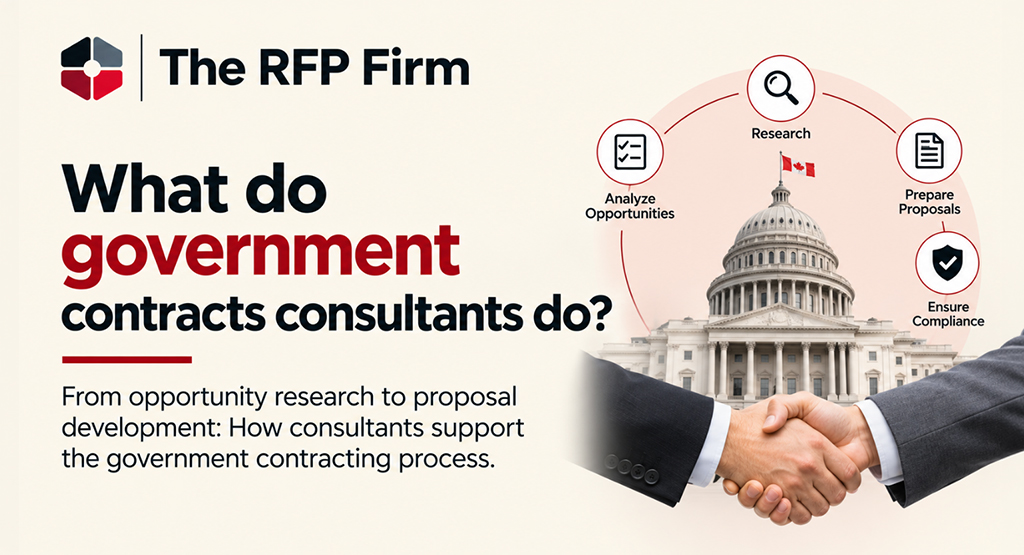
For companies that are just getting started in the world of government contracting or that want to seek out more challenging projects, the assistance of government contracts consultants is highly beneficial. Consultants can help businesses with all the stages of contracting from researching the opportunities to analyzing solicitations, creating proposals, ensuring compliance, and improving the processes.
What does a government contracts consultant do?
The services of the government contract consultant are to assist business in comprehending the processes of getting government contracts. The level of assistance provided varies depending on the business’s experience, the industry, the target market, and the type of contracts that the business is interested in.
Some consultants specialize only in proposal writing whereas others offer comprehensive assistance in research and opportunities analysis, market strategy, compliance and government contracting processes.
What areas can a consultant support?
Depending on the engagement, a consultant may help with:
- Government opportunity research
- Procurement history analysis
- Solicitation monitoring
- Bid/no-bid analysis
- RFP analysis
- Compliance matrix development
- Proposal strategy and development
- Technical and management content
- Staffing approaches
- Past performance
- Contracting strategy
- Market research
- Subcontracting or teaming opportunities
- Proposal review and quality control
The responsibilities of the consultant have to be established taking into account the real demands of the business, and not by the presumption that all companies need the same assistance.
How can consultants help businesses identify government contract opportunities?
Before developing any proposal, it should be clear for the business whether this particular opportunity fits its strengths and strategic plans. Chasing all possible solicitations requires significant effort and time, but does not yield any realistic chances to win.
A consultant can assist with organizing the process of researching so that the businesses could find opportunities that match their services, capabilities, target agencies, geographic coverage, resources, and experience.
What can consultants research?
Consultants may help businesses:
- Identify relevant agencies and contracting organizations
- Research previous government contracts and awards
- Monitor solicitation opportunities
- Review agency procurement forecasts
- Identify relevant NAICS codes and service categories
- Research incumbent contractors and competitors
- Evaluate potential prime-contracting opportunities
- Identify subcontracting or teaming opportunities
- Develop opportunity tracking systems
Through this research, an organization could transition from merely seeking solicitations to having a more planned out government contracting strategy.
Why do businesses work with government contracts consultants?
Government procurement involves the use of language, systems, procedures, documentation, and regulations that might be different from those used in commercial transactions. In some cases, despite the business’s success in the commercial field, it might have to adopt new systems to help it access government procurement contracts.
A consultant would offer an external source of information while giving the business the chance to control its technical expertise and information. The ideal consulting arrangement should aim at addressing areas where the business lacks capability.
Can consultants help with bid/No-bid decisions?
Yes. One important function here is assisting the organization in the process of analyzing the opportunity before making substantial investment in the proposal.
A simple bid/no-bid analysis may include:
| Evaluation area | Question to consider |
|---|---|
| Scope | Can the business perform the required work? |
| Experience | Does the business have relevant past performance? |
| Eligibility | Does it meet the solicitation requirements? |
| Staffing | Can the required personnel, qualifications, and coverage be provided? |
| Location | Can the business perform where required? |
| Resources | Are the necessary equipment, facilities, and technology available? |
| Contract size | Can the business support the financial and operational requirements? |
| Competition | Does the business have a credible competitive position? |
| Deadline | Is there enough time to prepare a quality response? |
This process helps distinguish opportunities that look attractive from those that are realistically achievable.
Can government contracts consultants help new government contractors?
Firms which are just beginning in government contracting would need to get familiar with procedures that might seem foreign within a business context. In the case of federal contracting, for instance, there is a need for registration and other aspects that should be sorted out beforehand.
Here the consultant would play a role in explaining the process, identifying administrative actions, and sorting out information that the firm should present. The responsibility for presenting the correct information still lies with the firm itself.
What should new government contractors understand?
New contractors may need to address areas such as:
- Federal registration requirements
- Unique Entity ID requirements
- SAM.gov registration and maintenance
- Applicable representations and certifications
- Solicitation requirements
- Proposal procedures
- Contract-specific compliance obligations
These requirements may differ and vary by opportunity; hence, businesses should confirm the applicable requirements through government sources.
How can consultants assist with the proposal process?
This is another aspect where consulting services can directly influence how the organization answers. The government may put down very specific requirements regarding methodology, staff, experience, prices, form filling, formatting, evaluation, and submission process.
A consultant can help sort out all these requirements and design a structure for the response that would make the whole process simpler. However, the experts from the organization must continue to be involved since it is they who will give the necessary technical details.
How do consultants evaluate an RFP?
A consultant may begin by breaking the solicitation into manageable requirements, including:
- Scope of work
- Mandatory requirements
- Evaluation factors
- Proposal instructions
- Required forms
- Technical requirements
- Staffing requirements
- Past performance requirements
- Pricing instructions
- Contract terms
- Submission requirements
- Deadlines
- Amendments
This information may then be arranged into a compliance matrix that links each criterion to the relevant proposal segment, source information, responsible party, and approval status.
How can consultants improve proposal content?
The role of the consultant in this case would be to steer the proposal away from being too descriptive of the company to focusing on information that pertains to the solicitation. The aim here would be to demonstrate how the company will fulfill the solicitation requirements and the relevance of the business to the solicitation.
The suggested order is:
Solicitation Requirement → Solution Approach by Business → Resources/Staffing → Related Experience → Quality Control
This method of presentation allows for linking the requirements of the solicitation with what the business plans to do in its fulfillment.
What proposal sections can consultants support?
Depending on the engagement, consultants may assist with:
- Executive summaries
- Technical approaches
- Management plans
- Staffing approaches
- Quality assurance sections
- Past performance narratives
- Transition plans
- Risk management
- Organizational information
- Proposal editing
- Final proposal production
The company must supply the underlying facts, whereas the consultant will assist in organizing and presenting the information.
How can consultants support staffing and personnel requirements?
The issue of staffing may be very critical in any proposal for government since the evaluation of the proposal might hinge on the ability of the business to provide the right people to do the work. Some of the aspects that will have to be covered include duties, qualifications, organizational structure, and availability.
The consultants could assist in organizing the information to come up with a staffing strategy in line with the solicitation. The business will still have to confirm the accuracy of the staffing plan.
What should a staffing approach address?
Depending on the solicitation, the proposal may need to explain:
- Required positions and roles
- Qualifications and experience
- Key personnel
- Staffing levels
- Coverage and scheduling
- Reporting relationships
- Supervision
- Training
- Recruitment or replacement procedures
- Continuity of personnel
- Resource availability
An adequate staffing portion will show that the organization has a practical plan for supplying the required personnel to accomplish the contract.
What compliance support can government contracts consultants provide?
Compliance entails more than the simple act of submitting an offer before the deadline. The company will have to consider solicitation-specific requirements, contracting requirements, mandatory forms and certifications, amendments, formatting requirements, and many others.
The consultant is capable of developing review systems that may aid in identifying any areas where compliance could be lacking. However, this does not mean that the duty of compliance is shifted away from the business to the consultant.
How can consultants help reduce proposal compliance problems?
A compliance review may check:
- Required sections
- Page limits
- Formatting
- Required forms
- Signatures
- Certifications
- Attachments
- Past performance information
- Pricing requirements
- Submission instructions
- Amendment acknowledgments
The final proposal can also be compared against the solicitation to confirm that requirements have been addressed in the appropriate locations.
What other government contracting support can consultants provide?
Writing proposals is just one aspect of the effort required to secure government contracts. The range of services being considered may involve consulting assistance in developing a strategy for a business to engage government procurement offices and understand their procurement patterns.
This kind of consulting may be valuable to a business wishing to set up a government contracting process instead of treating each proposal as a separate project.
Can consultants help with contracting strategy?
A consultant may help a business:
- Identify target agencies.
- Research previous contract awards.
- Review agency purchasing patterns.
- Identify potential competitors and incumbents.
- Assess prime-contracting opportunities.
- Explore subcontracting or teaming opportunities.
- Develop a pipeline of potential opportunities.
The business should use this information to determine which markets and opportunities align with its actual capabilities and resources.
Can consultants support small-business contracting strategies?
It is possible for small businesses to benefit from some federal contract programs if they satisfy the specified conditions. Knowing about such programs could assist the firm in identifying potential opportunities that might suit its needs.
A consultant could assist in identifying relevant programs; however, it would be important for the business to ensure that it is eligible for such programs based on information from the government agency.
Which federal small-business programs May be relevant?
Federal programs can include:
- 8(a) Business Development Program
- HUBZone Program
- Women-Owned Small Business Federal Contract Program
- Service-Disabled Veteran-Owned Small Business Program
Eligibility requirements vary by program and can change over time. Businesses should verify current requirements before pursuing an opportunity under a specific program.
When should a business engage a government contracts consultant?
Every business does not require consultancy services at all times. This is determined by various factors, including the experience of the organization, internal resources of the company, number of proposals made, contract targeted, and familiarity with the government’s process of procurement.
When there is some capability gap that is hindering a business from exploiting some opportunities, consultation could help. It will be wise to bridge the gap and not outsource functions that the business handles very well.
What are the signs that consulting support May be useful?
Consider consulting support when:
- The business is new to government contracting.
- There is no dedicated proposal personnel.
- Employees are spending excessive time preparing proposals.
- The team struggles to interpret complex solicitations.
- Proposals frequently contain compliance issues.
- Proposal deadlines are being missed.
- The business is pursuing larger or more complex opportunities.
- The organization needs a government contracting strategy.
- The business wants to expand from commercial work into government markets.
The appropriate level of support will depend on the specific challenge and the resources already available within the organization.
How do you select the right government contracts consultant?
Government contract consultants can vary widely in terms of experience, industry knowledge, services offered, and even in how proposals are developed. Companies must identify the kind of assistance they require before selecting any consultants.
There must be an emphasis on practicality when it comes to the assessment of any consultant. The consultant must be able to show how the job will be done, the company’s role, and what the business must provide for the consultant to perform his or her duties.
What should businesses look for?
Consider:
- Experience in government contracting: Experience in the type of work the firm is pursuing must be considered.
- Experience with proposals: Consider experience with RFP review, technical writing, compliance and management when proposal support is required.
- Industry experience: Industry experience may aid in the consultant’s understanding of technical specifications.
- Process: Inquire how the consultant manages opportunity analysis, content development, reviews and deadlines.
- Communication: Determine who will provide information and who will make the decisions.
- Accuracy: The consultant should base his/her work on verified company data rather than assumptions.
- Scope of service: Determine what the consultant will provide and what he/she will not provide.
Also businesses need to be careful with anyone guaranteeing contract awards. No consultant can influence the solicitation, competition, evaluation process and ultimately the award decision.
For those businesses that want professional proposal development and consulting, The RFP Firm offers services specifically geared to government and commercial proposal requirements.
How can businesses get more value from consulting support?
However, the best relationships between the consultant and the business client should be based on cooperation. While the consultant could offer expertise in procurement and proposals, the business should provide reliable data about their services, staff, experience, resources, equipment, and procedures.
It is especially true for proposals which contain complex requirements to the technical and staffing aspects. The business subject matter experts should check whether the developed approach is applicable.
One possible approach is:
- Business provides expertise
- Consultant organizes and develops the response
- Business checks reliability
- Consultant conducts quality and compliance review
Thus, the proposal will not contain any inaccurate information while receiving additional organization.
How can government contracts consultants support Long-term contracting success?
The worth of consulting assistance is not just to benefit from one opportunity. Businesses can leverage every chance to see the gaps in processes, to make improvements in proposal resources, to get better in market research, and to come up with a repeatable process of doing business with the government.
After completion of an opportunity, the organization will be able to find out what requirements were hard to meet, if there was enough staffing information, which past performance examples were the best, and which efforts in the proposal process were unnecessary. These findings will be helpful for future opportunities.
What do government contracts consultants actually help businesses accomplish?
Government contract consultants can help companies to bring order to a process which can otherwise be disorganized in opportunity research, proposal writing, compliance, and contracting strategy. The value of government contract consultants is not merely in the creation of documentation. They help to inform businesses of requirements and create systems for future use.
The most useful support may include:
- Identifying and evaluating suitable opportunities
- Conducting bid/no-bid analysis
- Analyzing solicitations and evaluation requirements
- Developing organized and compliant proposals
- Addressing staffing and personnel requirements
- Supporting contracting strategy and market research
- Improving proposal workflows
- Establishing quality-control processes
It is still incumbent upon the business to provide all information, representations, skills, and decision-making. A competent consultant like The RFP Firm would help with this by being an expert on contracting and proposals.
Frequently asked questions
The Government Contracts Consultant offers specialized services to companies seeking government contracts. Services provided by the consultant vary from contract to contract and may consist of opportunity identification, solicitation analysis, bid/no-bid assistance, proposal development, compliance, market research, and contract strategy.
Some consultants offer proposal writing and development services such as RFP review, compliance matrix, technical narrative, management approach, staffing, past performance, editing, and the final proposal itself. The services offered depend upon the consultant’s scope of work.
Yes. The consultant could assist the company in identifying relevant agencies, conducting research on previous procurements, monitoring solicitations, forecasting procurement, and identifying opportunities for primes, subcontractors, and teammates. Additionally, the business can seek opportunities at the federal level from SAM.gov.
Yes. The consultant may assist in organizing the information about staffing, people, roles, competencies, responsibilities, coverage, and management structures. The company needs to check if the information about the staffing is correct.
No. Even smaller firms which are relatively new to government contracts can make use of consulting services, especially if they don’t have any dedicated team preparing proposals.
Cost varies depending on several factors such as the consultant, nature of service, complexity of the project, the degree of support needed, and engagement. Organizations should consider what services are offered as well as the experience of the consultant.
Not one consultant is able to guarantee the receipt of a government contract. The consultant will be able to make the process more organized, improve its quality, and make it more responsive to the needs, but the ultimate result depends on the process itself.
It is also wise for an enterprise to consult prior to answering a complicated request, if the firm is just starting government contracting work, if its internal proposal capabilities are constrained, and/or if the company requires a more systematic government contracting approach.
Recent Posts
- What do government contracts consultants do? A complete guide for businesses
- How to use an RFP proposal template to save time and win more contracts
- How businesses can win more contracts through government proposals
- How to find and win government RFP opportunities in 2026
- What is an RFP in Canada? Everything businesses need to know