

How to find and win government RFP opportunities in 2026
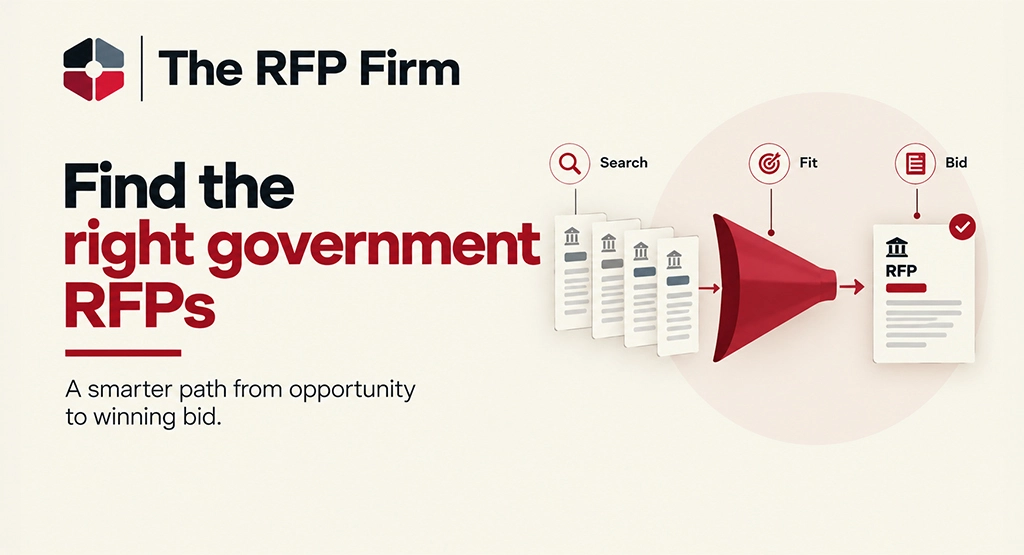
Government contracting can open up a real revenue stream for your business, but finding the right opportunity is only the first hurdle. Even organizations with strong credentials and solid experience can end up at a disadvantage by chasing solicitations that were never a good fit, or by submitting proposals that don’t actually answer what the agency asked for. Responding well to a government RFP starts long before you sit down to write it it starts with a reliable process for finding solicitations, screening them against your capabilities, understanding what the agency actually needs, and building a response around that.
Where can businesses find government RFP opportunities?
Finding opportunities consistently is one of the first things that separates a real government contracting pipeline from the occasional lucky find. Instead of searching randomly whenever time allows, it helps to build a routine around procurement databases and search criteria that actually match what your business does. That habit is what turns government contracting into a repeatable source of work rather than a one-off win.
How can you use Sam.Gov to find federal opportunities?
For federal contracting, SAM.gov Contract Opportunities is the primary source for publicly posted federal procurement notices. You can search opportunities using keywords and filters, follow specific listings, save searches, and track changes to solicitations as they happen, which matters more than it sounds like on longer procurements where amendments are common.
Useful search criteria include:
- Keywords related to your services
- NAICS codes
- Product or service categories
- Place of performance
- Agency
- Set-aside status
- Solicitation type
- Opportunity status
It’s also worth reviewing pre-solicitation and sources-sought notices. These often surface upcoming requirements well before a formal solicitation is issued, giving your business more time to prepare or even shape how the requirement is written.
Should you look beyond federal RFPs?
Yes, and depending on your market, it’s often where the more accessible opportunities are. Federal contracts get the most attention, but state and local governments, school districts, and public institutions issue a steady volume of RFPs with less competition.
Businesses that only watch SAM.gov are leaving a meaningful part of the government market unexamined. Opportunities worth tracking include:
- State governments
- Counties
- Cities and municipalities
- School districts
- Universities
- Public transportation agencies
- Healthcare organizations
- Public authorities
Each jurisdiction tends to run its own procurement portal, so it’s worth identifying which platforms the specific agencies and organizations you want to serve actually use, rather than assuming one search covers all of them.
How do you decide if a government RFP is worth bidding on?
Finding an opportunity isn’t the same as deciding to pursue it. A clear-eyed bid/no-bid assessment keeps your business from sinking real time and resources into a proposal it was never likely to win, which matters because that time could otherwise go toward opportunities with a genuine shot.
What should you check before bidding?
Review the solicitation against your organization’s actual qualifications, not the qualifications you’d like to have by the time the contract starts:
| Factor | Key Question |
|---|---|
| Scope | Do we have the expertise and resources required for the work? |
| Experience | Do we have relevant past performance? |
| Eligibility | Do we meet the stated eligibility requirements? |
| Location | Can we perform the work where required? |
| Staffing | Can we provide the required personnel? |
| Equipment | Do we have the required resources? |
| Certifications | Do we hold the required licenses or certifications? |
| Contract size | Can we financially and operationally support the contract? |
| Competition | Does the opportunity fit our competitive strengths? |
| Deadline | Are we able to submit an appropriate response in time? |
Why does the bid/No-bid decision matter?
Preparing a government RFP response pulls in people across the business technical staff, finance, leadership, and often subcontractors and that effort is expensive whether the bid wins or not. A weak bid/no-bid process means your team burns that capacity on opportunities with a poor fit, while stronger-fit opportunities get rushed or missed entirely. The better approach is to prioritize the solicitations where there’s a clear, honest connection between what your business can actually deliver and what the government is asking for.
How should you analyze a government RFP?
Once your business decides to bid, the solicitation needs a proper read-through before anyone starts drafting. Writing against an RFP you haven’t fully analyzed is one of the most common ways a qualified organization still turns in a non-responsive proposal.
What should your RFP analysis identify?
A thorough review should pull out every element that will shape the response, including:
- Scope of work
- Mandatory requirements
- Evaluation factors
- Submission instructions
- Required forms
- Page limits
- Formatting requirements
- Staffing requirements
- Past performance requirements
- Pricing instructions
- Certifications
- Contract terms
- Questions and clarification deadlines
- Proposal submission deadline
- Amendments
The evaluation criteria deserve particular attention here, since they tell your business exactly what the agency intends to weigh when scoring responses and a proposal that reads well but doesn’t map to those criteria will still lose to one that does.
Why build a compliance matrix?
A compliance matrix turns a dense solicitation into a working checklist your team can actually manage, which matters most on longer RFPs where it’s easy to lose track of a requirement buried on page forty. A simple version might look like this:
| RFP requirement | Proposal section | Supporting information | Status |
|---|---|---|---|
| Technical approach | Technical Approach | Operations methodology | In Progress |
| Staffing | Management Approach | Resumes and staffing plan | Pending |
| Relevant experience | Past Performance | Similar contracts | Complete |
| Quality control | Quality Management | QA procedures | In Progress |
| Required forms | Attachments | Company documents | Pending |
Keeping the matrix updated as the proposal develops makes it far easier to confirm every requirement has actually been addressed before anything goes out the door.
What makes your proposal actually qualify to win?
Even a fully compliant bid still has to convince the evaluator that your business can perform the work. Compliance gets you into the competition; the explanation of how you’ll deliver is what actually wins it.
How do you connect your bid to the evaluation factors?
Every major evaluation factor deserves a direct, specific response. Instead of a generic line like “our business provides high-quality services,” explain exactly how your organization will satisfy that particular requirement. A strong response generally walks through the same chain for each requirement: what it’s asking for, how your organization will approach it, what resources will be applied, what experience backs it up, and how quality will be controlled.
Working through that chain for each major requirement helps evaluators see not just what your business can do, but how it actually intends to do it which is usually what separates a compliant proposal from a winning one.
How can past performance strengthen a proposal?
Past performance is where your proposal stops making claims and starts showing evidence, which is exactly why it carries so much weight in most evaluations. Rather than listing every client your business has ever had, select the handful of projects that genuinely resemble this opportunity. Useful examples should show similarities in:
- Scope
- Size
- Complexity
- Service type
- Performance requirements
- Customer environment
Where the solicitation allows it, include verifiable specifics about what your business actually accomplished on those projects, rather than a general description of the relationship.
What government contracts are available to small businesses?
Government contracts can be genuinely significant for small businesses, depending on the specific program and set-aside category involved. According to the SBA, federal agencies work toward a government-wide target of awarding at least 23% of prime contract dollars to small businesses, and additional programs exist for categories such as women-owned small businesses, service-disabled veteran-owned small businesses, small disadvantaged businesses, and HUBZone small businesses.
What are set-asides?
Certain federal contracts are set aside specifically for qualified small businesses or particular categories within that group. Before relying on a set-aside, it’s worth confirming a few things rather than assuming eligibility:
- Your applicable NAICS code
- SBA size standard
- Registration status
- Required certifications
- Eligibility requirements in the solicitation
- Any applicable limitations on subcontracting
SBA size standards vary by industry and may be based on employee count or annual receipts, so it’s worth verifying your business’s status against current SBA requirements directly rather than assuming last year’s determination still applies.
What government RFP pitfalls should you avoid?
Even experienced contractors run into the same avoidable mistakes when preparing a government proposal, and most of them come down to process rather than a genuine lack of qualification. The most frequent ones include:
- Chasing a bid mainly because of its dollar value, even when the opportunity doesn’t play to your actual strengths
- Starting to write before the solicitation has been properly analyzed, which leads to missed requirements later
- Leaning on generic company descriptions instead of explaining how you’ll meet the specific requirement
- Overlooking amendments, which can change requirements, attachments, or submission instructions without much warning
- Treating compliance as a final formatting pass instead of building it into the process from the start
- Making claims about experience, staffing, certifications, or equipment that aren’t backed by facts
How can you improve your government RFP win strategy?
Winning more government opportunities takes a repeatable process, not a stronger effort on any single proposal. Businesses that treat every RFP as a one-off tend to relearn the same lessons every time; the ones that build a process get faster and more consistent with every bid.
What should your process include?
- Monitor opportunities using relevant procurement portals and saved searches
- Screen opportunities against your capabilities and eligibility
- Make a bid/no-bid decision based on objective criteria
- Analyze the solicitation and supporting documents
- Build a compliance matrix and proposal schedule
- Assign responsibilities to subject matter experts
- Develop the proposal around the evaluation criteria
- Conduct technical and management reviews
- Complete a compliance review against the solicitation
- Perform final production and submission checks
Businesses pursuing federal opportunities can also draw on the SBA Federal Contracting program, which provides information on contracting requirements, assistance programs, size standards, and other federal contracting resources.
When should you consider professional proposal support?
Some businesses can manage smaller government proposals internally without much trouble. Others need additional support once an opportunity involves extensive technical requirements, multiple volumes, complex compliance rules, or a deadline that doesn’t leave much room for error.
What can a proposal writing team help with?
Professional proposal support can cover as much or as little of the process as your business needs, including:
- Government RFP analysis
- Compliance matrix development
- Proposal strategy
- Technical writing
- Management approaches
- Past performance development
- Executive summaries
- Editing and proofreading
- Compliance reviews
- Final proposal production
For businesses that need additional proposal expertise, The RFP Firm provides proposal writing and consulting support built around government RFP requirements.
External support doesn’t replace your organization’s technical knowledge your business is still responsible for the accuracy of what goes into the proposal, including its capabilities, experience, personnel, pricing, and proposed approach. A proposal team builds the case around that information; it can’t invent it.
Conclusion
Locating and winning government RFPs isn’t just about researching contracts and submitting proposals on time. It takes an overall strategy that ties together opportunity identification, qualification, solicitation analysis, proposal development, and compliance verification, so that each bid is a deliberate decision rather than a reaction to a deadline. The most critical components of that strategy are:
- Searching consistently for relevant opportunities
- Evaluating opportunities before committing resources to a proposal
- Analyzing requirements and evaluation criteria before writing begins
- Building responses around the government’s specific needs
- Confirming compliance before every submission
The goal isn’t to submit more proposals it’s to identify the right contracts and respond in a way that demonstrates your business can actually deliver. Get in touch with The RFP Firm, and our proposal writers can help you build a compliant, competitive response.
Frequently asked questions
Federal opportunities can be found through SAM.gov Contract Opportunities. State, local, and other public-sector procurement portals vary by jurisdiction, so it’s worth identifying the specific platforms used by the agencies you want to work with.
Check the scope of work, eligibility requirements, experience, staffing, location, certifications, contract size, competition, and deadline against what your business can actually deliver. If you can’t meet a mandatory requirement, the solicitation isn’t a good fit.
Yes. Federal agencies work toward small business contracting targets, and some contracts are set aside for eligible small businesses or specific small business categories. Your business still needs to meet the applicable SBA requirements and the specific solicitation’s eligibility criteria.
Read the entire solicitation and all its attachments before writing anything. Identify the mandatory requirements, evaluation criteria, deadlines, and required forms first, so the proposal is built around what’s actually being asked.
Bid on opportunities where your business can demonstrate the required expertise, meet every mandatory requirement, align the response directly to the evaluation criteria, and back every claim with appropriate evidence.
A compliance matrix is a tracking document that maps each solicitation requirement to a proposal section, the contributor responsible for it, supporting information, and its completion status.
It can help significantly when your team lacks proposal writing experience, the RFP is complex, several people need to contribute, or the deadline leaves little room for error.
Recent Posts
- How businesses can win more contracts through government proposals
- How to find and win government RFP opportunities in 2026
- What is an RFP in Canada? Everything businesses need to know
- What is proposal consulting and how can it help your business?
- Government request for proposal: A complete guide for businesses