


Government request for proposal: A complete guide for businesses
Government contracts can open up serious revenue, but going after one takes a different playbook than a normal sales pitch. A government request for proposal comes loaded with instructions, evaluation criteria, contract terms, and submission rules, and you have to work through all of it before you write a single word of your response. Miss a requirement buried on page 40 and it won’t matter how strong the rest of your proposal is the government scores what’s written, not what you meant to say.
That’s the part most businesses new to this space underestimate. You rarely lose a government contract because you can’t do the work. You lose it because you didn’t show the agency you understood what it wanted, in the exact format it wanted it in.
- Most businesses that struggle with a government request for proposal don’t lack the capability to do the job, they lack a clear read about what the agency is asking for and how it wants that answer delivered.
- The RFP tells you exactly what the government wants and precisely how it will score your response, so treat it like an instruction manual, not a formality.
- Your proposal has to satisfy technical, management, past performance, pricing, and administrative requirements all at once, and skipping even one can sink an otherwise strong bid.
What is a government request for proposal?
A government request for proposal is how an agency formally tells the market what it needs and invites qualified businesses to respond. It’s not a casual ask. FAR 15.203 spells out exactly what a competitive RFP has to include: the government’s requirement, the anticipated contract terms, the information your proposal needs to contain, and the evaluation factors the agency will use to score you, along with how much each factor matters.
That last part is worth sitting on. Agencies can’t grade you on criteria they never disclosed, which means every RFP is also handing you the answer key, you just have to read it closely enough to use it. Federal opportunities are posted daily on SAM.gov Contract Opportunities, and in fiscal year 2025 the federal government committed roughly $793 billion to contracts, so the opportunities are real even when the process feels intimidating.
How does a government RFP differ from RFQ or RFI?
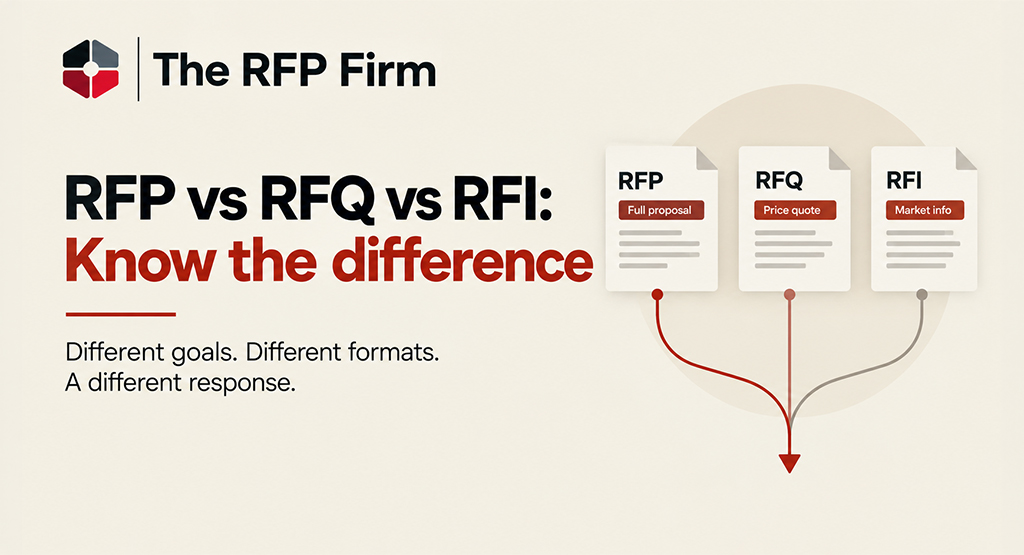
Not every government solicitation is asking for the same thing, and knowing which one is in front of you changes how you should respond. RFP wants a full proposal covering your approach, your qualifications, and usually your pricing. The RFQ is closer to a straightforward quote for something the government has already defined in detail. While RFI is the agency doing market research it isn’t buying anything yet.
| Solicitation | Primary purpose | Typical response |
|---|---|---|
| RFP | Solicit proposals for a defined requirement | Detailed technical and/or management proposal, with pricing as required |
| RFQ | Obtain quotations, often for clearly defined products or services | Quote based on stated requirements |
| RFI | Gather market information before a potential acquisition | Information about capabilities, solutions, or market conditions |
| IFB | Solicit sealed bids under applicable procedures | Formal bid, generally evaluated under sealed bidding rules |
Confirm the solicitation type before you start drafting. Building a full technical proposal in response to an RFI, or a barebones quote in response to an RFP, wastes time and tells the evaluator you didn’t read carefully.
What shows up inside a government RFP?
A government RFP can run long, and for good reason it usually bundles technical requirements, contract clauses, forms, exhibits, attachments, and detailed proposal instructions into a single package. Skimming is how businesses miss the requirements that actually decide the award.
For federal negotiated solicitations, agencies often organize this material using the Uniform Contract Format, which breaks the document into standard sections: schedule, contract clauses, attachments, representations and certifications, proposal instructions, and evaluation factors. Once you know that structure, a 150-page RFP stops feeling like a wall of text and starts feeling like a checklist.
What should you look for first?
Before you write anything, pull these details out of the solicitation and confirm them:
- Solicitation number and title.
- Issuing agency and contracting office.
- Proposal due date and time.
- Questions and clarification deadline.
- Period of performance.
- Place of performance.
- Scope of work or performance work statement.
- Proposal submission instructions.
- Evaluation criteria.
- Required forms and certifications.
- Past performance requirements.
- Pricing requirements.
- Contract terms and clauses.
- Amendments and attachments.
Building this list at the outset is what keeps you from discovering a missing form the night before submission.
Why are evaluation criteria so important?
The evaluation criteria tell you exactly how the government will judge your proposal, and FAR 15.203 requires competitive RFPs to spell out the evaluation factors and significant subfactors along with their relative importance. That’s not boilerplate, it’s the government showing its hand before you’ve written a word. Writing to the scope of work alone isn’t enough, because two businesses can both be technically capable and still score very differently based on how well they addressed what the agency actually said it cared about.
Your response needs to be built around how the agency says it will score you, not just around what it says it needs. Treat every evaluation factor as a required section, not a suggestion, and make sure an evaluator can find your answer to each one without hunting for it.
How should you respond to a government RFP?
Responding to a government request for proposal works best as a controlled process, not a writing sprint the week before it’s due. The businesses that consistently win treat the response like a project with its own milestones, owners, and review gates.
How do you analyze the RFP?
Start by breaking the solicitation into individual requirements instead of reading it once and starting to write. A practical sequence looks like this:
- Read the entire solicitation and every attachment.
- Identify the mandatory requirements.
- Review the evaluation criteria.
- Record every required form and document.
- Note the questions and clarification deadlines.
- Build a compliance matrix.
- Assign proposal sections to the people responsible for them.
- Set internal review deadlines.
- Develop and review the final proposal before submission.
Working through these steps in order is what turns a dense solicitation into a manageable project plan.
What is a proposal compliance matrix?
A compliance matrix connects each requirement in the solicitation to the exact section of your proposal that addresses it, along with who owns that section and where it stands. It’s the single easiest tool for catching a missed requirement before the government does. For example:
| Requirement | Proposal section | Owner | Status |
|---|---|---|---|
| Technical approach | Technical approach | Operations team | In progress |
| Relevant experience | Past performance | Management | Complete |
| Staffing requirements | Management approach | HR / Operations | In progress |
| Required certification | Attachments | Administration | Pending |
| Pricing submission | Price volume | Finance | Complete |
Keep the matrix open and updated throughout the proposal, not just at the end that’s what makes it useful instead of decorative.
What makes a government proposal competitive?
Compliance gets you in the door, but it doesn’t win the award on its own. Once you’ve confirmed you can meet every requirement, the real work is proving you’re the strongest choice among everyone else who also met them. Evaluators are comparing you directly against competitors who cleared the same bar, so the businesses that win are the ones that make their advantage obvious rather than assuming it speaks for itself.
That advantage shows up in four places: how well you prove technical capability, how relevant your past performance is, how tightly you manage compliance, and how clearly, you connect all three back to what the agency asked for.
How Do You Prove Technical Capability?
Your technical response needs to explain how you’ll actually perform the work, not just restate what the government already told you it needs. Evaluators read dozens of proposals that repeat the statement of work back to them; the ones that stand out explain the plan behind the promise.
Cover your proposed methodology, your work processes, your quality controls, your staffing approach, your equipment and resources, how you’ll monitor performance, how you’ll manage risk, and how you’ll communicate with the government throughout the contract. Give the evaluator enough detail to picture your team actually doing the work, not just claiming it can.
How Should You Present Past Performance?
Past performance only helps you if it’s relevant, so prioritize examples that match the current opportunity in scope, size, complexity, customer type, and performance environment rather than simply picking your biggest or most recent contracts.
For each example, explain what you did and connect it directly to why it matters for this requirement. A vague reference letter tells the evaluator less than two tight sentences that map your past work into their current need.
Why Does Compliance Matter as Much as Persuasion?
A proposal can showcase real strengths and still lose if it doesn’t follow the solicitation’s instructions to the letter. Government evaluators aren’t grading on effort they’re checking boxes against a published process, and a missed instruction can knock you out regardless of how good the rest of your response is.
Watch for missing forms, incorrect formatting, unanswered requirements, exceeded page limits, missing signatures, inconsistent company information, unacknowledged amendments, and late submission. Government proposal development takes both persuasive writing and disciplined compliance management working together, neither one covers the other.
The most common government RFP mistakes
Businesses new to government contracting often approach RFP the way they approach a commercial sales pitch, and that mismatch shows up fast in the response. The result is usually a proposal that presents the business well without actually answering the solicitation in front of it.
Which mistakes should you avoid?
| Common mistake | Why it creates a problem |
|---|---|
| Using generic content | Doesn’t demonstrate understanding of the specific requirement |
| Ignoring evaluation criteria | Leaves important scoring areas insufficiently addressed |
| Missing mandatory forms | Creates a compliance issue that can disqualify the proposal |
| Repeating the statement of work | Doesn’t explain how you’ll actually perform the work |
| Weak past performance | Fails to establish relevant, credible capability |
| Last-minute writing | Leaves insufficient time for review and quality control |
| Inconsistent information | Undermines the proposal’s overall credibility |
| Ignoring amendments | Risks responding to outdated or superseded requirements |
The best way to avoid this list isn’t a better final review, it’s starting the compliance and planning work before you write a single section.
When should you bring in professional proposal support
Not every government opportunity needs outside help. But when the RFP is long, complex, or genuinely important to your business, professional support can be the difference between a compliant submission and a rushed one. It’s also worth considering when you’re chasing several solicitations at once, or when your internal team is strong technically but has never built a proposal around a formal evaluation scheme before.
The goal isn’t to hand off your expertise, it’s to get help organizing it into the structure the government is actually going to score.
What can a proposal writing service help with?
A professional proposal team can support RFP analysis, compliance matrix development, proposal planning, technical writing, management approach development, past performance presentation, executive summaries, editing and proofreading, compliance reviews, and final proposal production.
If your business needs support preparing government proposals, The RFP Firm provides proposal development and related services built around exactly this process. Bringing in professional support doesn’t replace your subject matter expertise, it takes what your leaders and technical staff already know and turns it into a structured, evaluator-ready response.
How to build a better government proposal process
A repeatable process is what makes your third RFP easier than your first. Instead of rebuilding everything from scratches each time, maintain a proposal resource library with current company information, resumes, past performance examples, client references, certifications, organizational charts, policies and procedures, technical information, and relevant case studies.
Standard content speeds up your draft, but it should never replace opportunity specific writing. Every government RFP deserves to be read and answered on its own terms, even when half your content comes from the library.
Build a more rigorous government RFP response process
A government request for proposal gives your business a real shot at winning contract work, but getting there takes more than filling out forms and hitting the deadline. It takes meticulous solicitation analysis, disciplined compliance monitoring, genuinely relevant experience, technical responsiveness, and a rigorous quality review before anything goes out the door.
If you’re pursuing government contracts, read the entire solicitation before you start drafting, build a compliance matrix around the actual requirements, align your content with the evaluation criteria, back up every claim with specific evidence, and confirm the final submission is complete and compliant before you submit it.
Businesses that pursue government contracts regularly benefit from building this into a repeatable process, or from bringing in experienced proposal writers to manage it for them.
Frequently asked questions
It’s an official solicitation that an agency issues to tell qualified contractors what it needs and how it will evaluate their responses, governed in part by FAR 15.203.
SAM.gov Contract Opportunities is the primary source for federal solicitations you can search by keyword, solicitation number, agency, and several other filters to find opportunities that match your business.
Read the full solicitation along with every attachment and amendment, identify the mandatory requirements, review the evaluation criteria, and build a compliance matrix before you start drafting any content.
An RFP asks for a full proposal built around requirements and evaluation criteria, while an RFQ is generally looking for a quote on clearly defined products or services the solicitation itself will tell you which one you’re dealing with.
Small businesses compete for and win government contracts regularly, especially with federal set-aside goals in play, as long as they meet the solicitation’s stated requirements.
Critical FAR 15.203 requires agencies to disclose the evaluation factors and subfactors along with their relative importance, so your response should be built around exactly what the agency says it’s scoring.
No legitimate proposal writing business can guarantee an award. What it can do is sharpen your organization, compliance, and clarify the proposal. The government still makes the final call.
Recent Posts
- Government request for proposal: A complete guide for businesses
- What is a request for proposal: Everything you need to know
- Format of business proposal: A complete guide for beginners
- The best proposal template Canada businesses can use in 2026
- How business proposal writing services help companies win more clients